Commit-Based Skill Profiling: How AI Dev Command Knows Your Team Better Than You Do
Engineering managers assign tasks based on gut feeling. "Sarah is good at frontend. Ahmed knows the payment system. Nour is fast but sometimes skips tests." These mental models are incomplete, biased by recency, and invisible to everyone else on the team.
The result: tasks land with the wrong person more often than anyone admits. That means reassignment, context-switching, and wasted sprint capacity. Multiply that across every sprint for a year and you are looking at months of lost productivity that nobody tracks because it is baked into the way teams have always worked.
What We Built
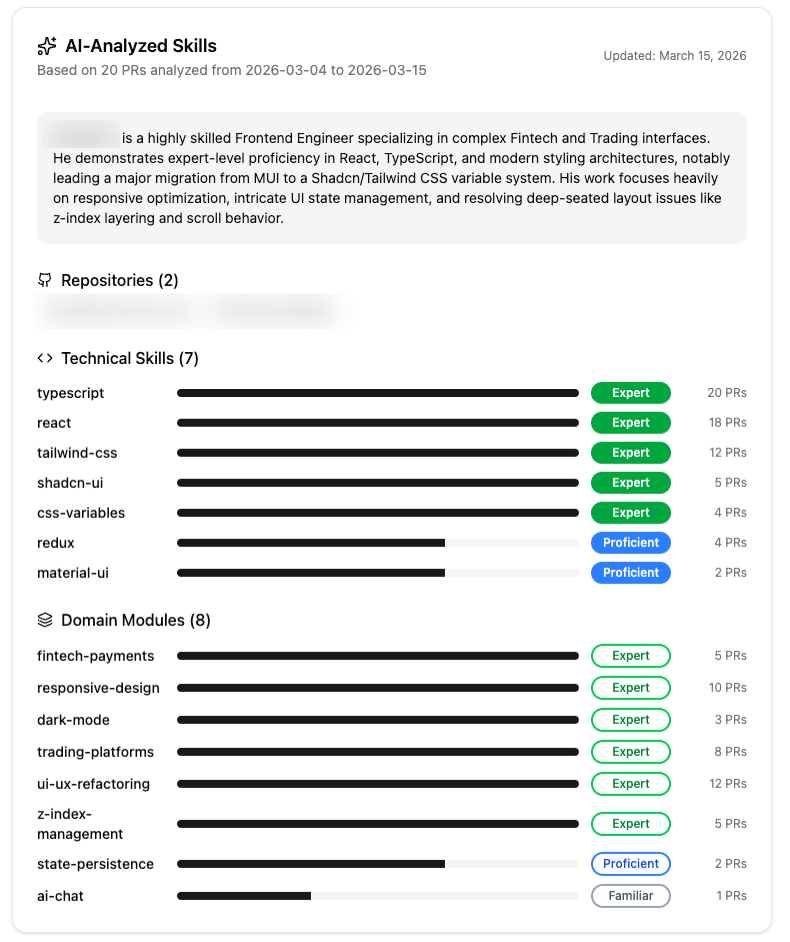
We built a skill profiling system inside AI Dev Command that constructs developer profiles from Git history. It analyzes every commit, pull request, code review, and deployment to map what each developer is actually good at -- not what they claim on their resume or what their manager assumes.
The system processes four data sources from your Git repositories:
Commit History: Language distribution, file path patterns, commit size patterns, and code complexity metrics. If someone consistently commits to payments and billing modules, they have payments domain expertise. The system knows this without anyone telling it.
Pull Request Data: PR size, cycle time, and number of review rounds before approval. Fewer review rounds indicates higher first-pass code quality. The system tracks this over time to see trends, not just snapshots.
Code Review Activity: How many PRs they review, how deep their reviews go, and what proportion of their review comments identify actual issues. A developer who catches real problems in review is demonstrating depth that no self-assessment captures.
Deployment Data: How often their code ships, incident correlation, rollback rate, and fix speed. This closes the loop -- it is not just about writing code, it is about writing code that works in production.
These signals are aggregated into a profile covering language proficiency, domain expertise, code quality, collaboration patterns, and velocity. Each dimension is continuously updated as new commits and reviews come in.
The system then uses these profiles for intelligent task routing. When a new task enters the system, the routing engine analyzes what it requires and matches it against developer profiles. Teams can configure routing policies: best match always picks the highest-scoring developer, balanced load distributes evenly, and growth-oriented intentionally routes some tasks to developers building skills in that area.
Why We Built This
Task assignment in engineering teams is one of the last major manual bottlenecks in software development. We have automated testing, automated deployment, automated code review. But deciding who should work on what? That is still a manager looking at a board and making a judgment call with incomplete information.
We built skill profiling because the data to make better decisions already exists in your Git history. Every commit is a signal. Every review is a signal. Every deployment is a signal. The problem is that no human can process all of that data across an entire team and keep it current. Automation can.
This system is in production. Engineering teams use it daily for task routing, and the impact is immediate. Tasks stop bouncing between developers. Sprint plans hold together because work is assigned to the people best equipped to complete it. Review cycles shorten because code quality improves when the right person writes it the first time.
Beyond task routing, the system surfaces team-level risks that are otherwise invisible. Bus factor analysis shows which parts of your codebase only one person knows. Skill gap detection identifies capabilities underrepresented on the team, which drives targeted hiring and training decisions. These are insights that used to require expensive consulting engagements or painful post-mortems. Now they update in real time.
Who This Is For
If your engineering team experiences frequent task reassignments, uneven workload distribution, or knowledge concentration risks, skill profiling turns gut-feel task assignment into data-driven matching.
To see it in action, we will connect to your repository with read-only access, generate profiles for your team, and walk you through the findings. Contact info@salem.ventures.

